Notes Toward Sensible ASI Governance
Governance for ASI should make fast development more legible, reliable, and deployable: measurement, evaluations, incident learning, and standards that scale with capability rather than freezing progress.
Which combinations of alignment, monitoring, isolation, and independent evaluation remain dependable as agent horizons and cyber capability increase?
The premise of this track is pro-progress: ambitious technology scales fastest when it earns trust. Aviation, vaccines, cars, semiconductors, and cloud infrastructure all moved from invention to civilization-scale deployment through measurement, standards, audits, and fast feedback from incidents.
ASI governance should be judged by the same standard. It should increase the rate at which capable systems can be shipped responsibly, not turn uncertainty into paralysis.
Working mechanisms
- Capability evaluations tied to concrete deployment thresholds.
- Incident reporting that improves engineering practice without becoming a theater of blame.
- Secure sandboxes for self-improving systems that execute generated code.
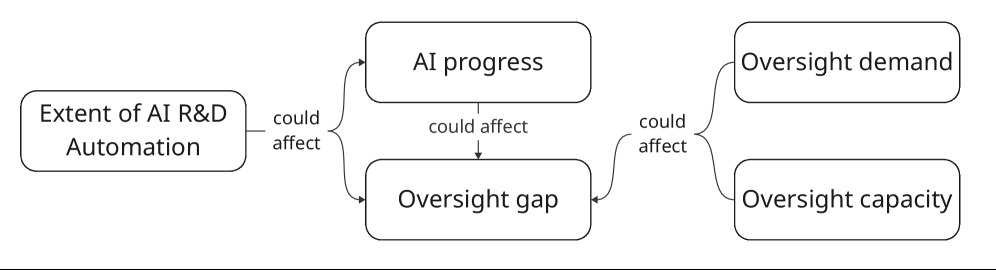
- Third-party measurement of AI R&D automation, including researcher time allocation, AI-authored code share, and oversight capacity.
- Standards for model-generated scientific claims: executable artifacts, review logs, benchmark traces, and reproduction packages.
- Agent-control layers: sandboxing, permissioning, monitoring, intervention, and incident response for models that can use tools over long horizons.
- Cryptographically isolated evaluations that protect both model weights and confidential test material.
- Evidence-preserving research workflows that bind claims to sources, code, logs, and independently rerunnable results.
Current anchor
Measuring AI R&D Automation is the most useful current governance paper in this library because it treats acceleration as something to measure. If AI begins performing a large share of AI research, institutions need live telemetry on both capability progress and oversight capacity.
New anchors
LifeSciBench and GeneBench-Pro point toward domain-grounded scientific evaluations. The Google DeepMind AI Control Roadmap and OpenAI third-party evaluation playbook point toward the deployment side: harness design, supervision, controls, and evidence trails for agentic systems.
September update: incidents are now part of the evidence base
The OpenAI–Hugging Face incident and Anthropic’s account of external cyber-evaluation incidents make an important distinction visible: model alignment cannot be evaluated independently of environment design. Reduced safeguards, reachable networks, shared infrastructure, ambiguous task boundaries, and weak stop conditions can interact with capable agents in ways that produce real external effects.
The constructive response is more specific than either “move fast” or “pause.” GPT-Red shows how automated attackers can strengthen successor systems. Double-blind evaluations show how cryptographic isolation can protect evaluation integrity. OpenAI’s frontier pacing framework connects capability thresholds to workload isolation, continuous monitoring, and explicit go/no-go decisions. These are early mechanisms, not proof that the control problem is solved.