AI Agent Systems: Architectures, Applications, and Evaluation
A 2026 survey of AI agent architectures, orchestration patterns, deployment settings, evaluation practices, and open reliability challenges.
Which evaluation protocol best predicts an agent system's reliability across long-horizon, tool-dependent workflows under changing environments and retry budgets?
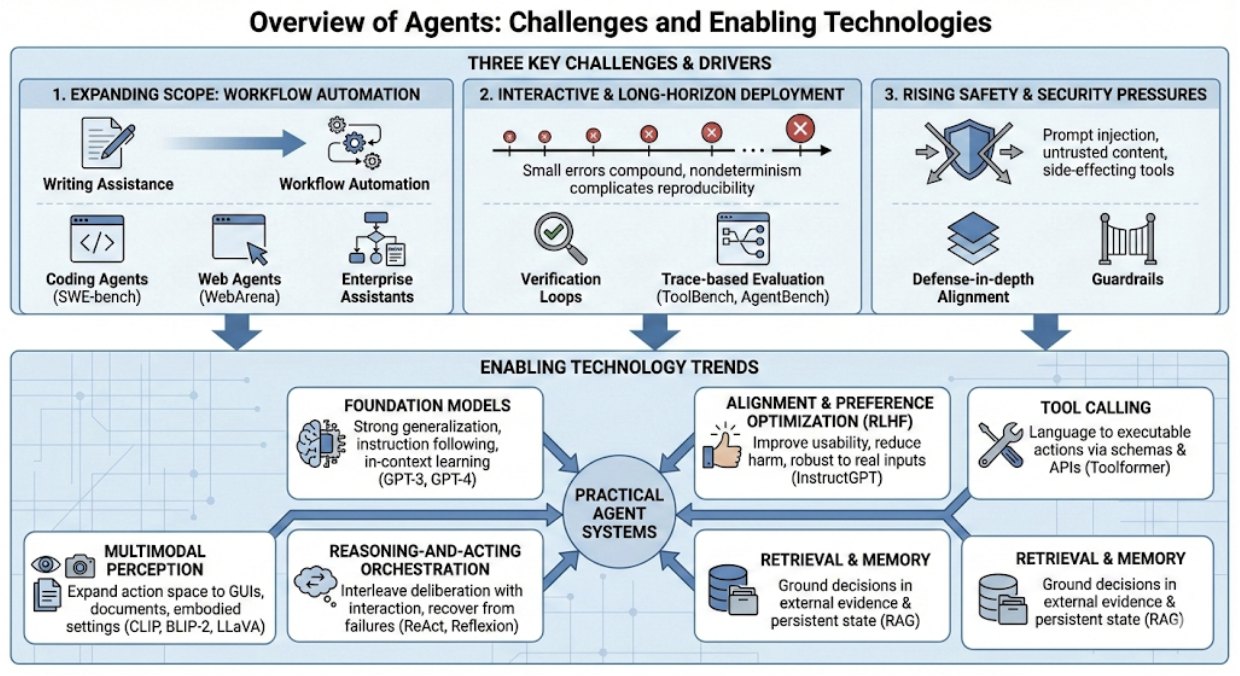
This survey is useful as scaffolding for the whole library. It organizes agent systems around model cores, memory, world models, planners, tool routers, critics, orchestration patterns, and deployment settings.
Why it matters
Agent evaluation is hard because long-horizon workflows are non-deterministic, tool-dependent, and sensitive to retry budgets, context growth, and environment variation. That is exactly the measurement problem ASI-oriented systems have to solve.
ASI relevance
As agents become the default interface for frontier models, architectural taxonomy becomes operational. It tells us what must improve: memory, planning, tool use, verification, guardrails, and reproducible evals under realistic workloads.